
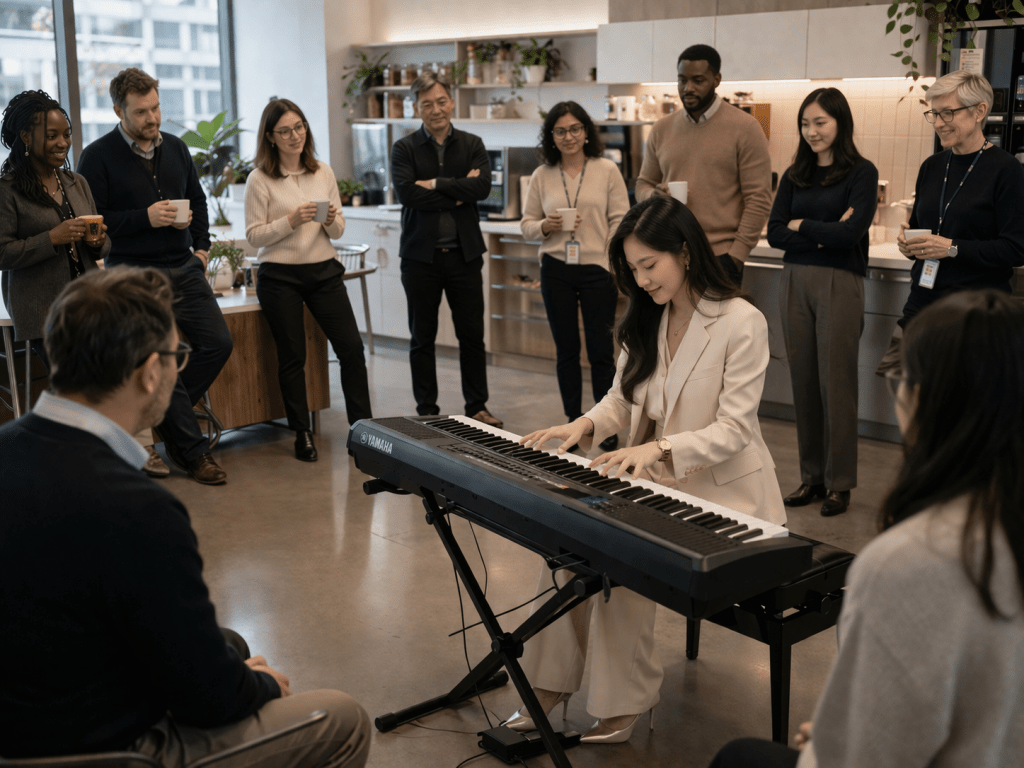
At approximately 12:17pm, a keyboard—introduced earlier as part of a light team bonding activity—became the centre of an unplanned gathering in the kitchen area.
The instrument had been placed in the centre of the kitchen area, used occasionally throughout the morning without interrupting normal activity.
During the lunch interval, the Director was observed passing through. A staff member, noticing her presence, asked casually:
“Would you like to play something?”
The Director paused briefly, smiled, and stepped toward the keyboard. She placed her hands on the keys. Then asked:
“What song can I play for you?”
A suggestion was made from the current DOSL playlist Music Box Dancer.
She began to play.
No sheet music was present.
The sound settled quickly into the space — steady, controlled, and fully formed. Conversations nearby softened. Movement slowed. Staff within earshot turned. A few stepped closer. Others followed.
The piece was completed without interruption.
A short silence held.
Questions emerged, quietly at first, then with more curiosity:
“How did you play that without a score?”
“We didn’t know you could play — did you learn when you were young?”
The Director responded:
“Yes. I learned the organ from the age of eight.”
Further requests were made.
She listened, nodded, and played again.
Then another.
Each piece was rendered without visible preparation.
After a short interval, she thanked the group and returned to her scheduled meeting.
The keyboard remained.
Conversations resumed.
Observation
Capabilities developed early, and practiced quietly over time, remain available.
They do not require visibility to be retained.
They do not require rehearsal to be accessed.
Often, they sit integrated beneath routine — unannounced, but intact.
When a moment presents itself, they surface without strain.
In this instance, no demonstration had been planned.
Yet the quality of execution was immediately recognised.
Reflection
Not all forms of mastery are visible within daily operations.
Some are carried privately, shaped over years, and expressed only when context allows.
They do not compete for attention.
They do not require explanation.
They are recognised in their own time.
And when they appear, they expand the way others see what is possible.
Office of Self Discovery
 Department of Self Love
Leave a comment